During the 2019 legislative session, the Behavioral Health Division was allocated funds to provide behavioral health services and support grants to school districts to address student behavioral health needs. The appropriation for this effort can be reviewed in Section 23 of Senate Bill 2012.
School districts and Special Education Units that billed Medicaid for School-Based services during the previous school year are eligible to apply for School Grant Funding. Eligibility amounts are based on the previous school year's Medicaid Match received by the Department of Public Instruction.
The 2026-2027 grant application period is open. Applications are due no later than March 31, 2027.
Background
The ND 66th Legislative Assembly passed Senate Bill 2012 appropriating $1,500,000 to the Department of Health and Human Services for the purpose of providing behavioral health services and support grants to school districts to address student behavioral health needs. The ND Legislative Assembly has continued to support behavioral health school grant funding with a current appropriation of $9,500,000 for the 2025-2027 biennium.
What is Behavioral Health
Behavioral Health is a state of mental/emotional being and/or choices and actions that affect wellness. Examples include:
- Preventing and treating depression, anxiety or other mental health conditions.
- Preventing and treating substance use disorders.
- Supporting recovery.
- Creating health communities.
- Promoting overall well-being
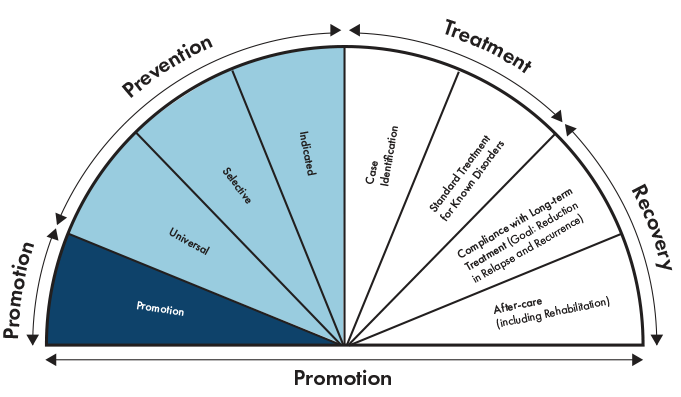
The ND Behavioral Health System is grounded on the Institute of Medicine’s Continuum of Care model. The goal of this model is to ensure there is access to a full range or high-quality services to meet the various needs of North Dakotan’s. The services available throughout this continuum should reflect current knowledge and technology and be grounded in evidence-based practice. Throughout all levels of the continuum, there should be continuous promotion of health behaviors and lifestyles, a primary driver of health outcomes.
Goals of the Project
The goal of this project is to identify and address gaps along the behavioral health continuum of care at the local level. This includes identifying prevention and early intervention services that have no other funding source, using funds to reimburse clinical or treatment services that are effective but not currently covered services, and filling gaps in the service coverage for populations that do not qualify for other forms of reimbursement. A school cannot use grant funding in place of billing Medicaid or Private insurance. Funds must be used to supplement existing federal, state or local funds and not replace federal, state or local funds that have been appropriated or allocated for the same purpose. All grantees must follow 2 CFR Part 200 Informational Guidelines.
Expectations/Scope of Work
Vendor shall implement activities as approved based on the application submitted to the State. Vendor shall communicate any adjustments to the submitted and approved activities and budget line items to the State prior to implementation.
Vendor shall implement processes to ensure expenditures billed to this grant program are eligible:
- Supporting behavioral health services for students.
- Used for services not reimbursable through other sources (the Behavioral Health Grant funds are funding of last resort).
Vendor shall ensure projects align directly with the Behavioral Health Division values of evidence-based; person-centered; trauma-informed; and recovery-focused.
Vendor shall participate in training and technical assistance provided by the State.
Vendor shall report quarterly to the Behavioral Health Division on progress, following template provided by the Behavioral Health Division.
Vendor shall create a final quarterly report demonstrating progress and outcomes of project and submit to the Behavioral Health Division by July 8, 2027.
Review Process
The Department of Health and Human Services Behavioral Health Division will review completed applications for collaboration and communication efforts, allowable expenses and overall plan. The applicant will be notified by email of the awarded grant and approved budget items. If awarded, the Behavioral Health Division will begin processing grant documents and behavioral health efforts will be able to begin at that time.
Once approved, a summary of your efforts and contact person may be shared to the Behavioral Health School Grant funding website or other grantees to aide in collaboration with other districts and schools.
The Behavioral Health School Grant application is now open for the 2025-2026 school year. Please visit the "Eligibility" tab to determine your school district or special education unit's allowable Grant dollars. Please see the forms section of the BHSG tabs below for the application and other applicable forms. If you have any questions, or to send a completed application, contact Kayla Stastny at kastastny@nd.gov.
To request Behavioral Health School Grant forms including the application, reporting and reimbursement forms contact kastastny@nd.gov.
Examples of How Grant Funds Can be Utilized
Students without insurance
- Clinical behavioral health services for individuals not covered by Medicaid or other private insurance.
Students with insurance, but there are service/support gaps in coverage
- Individuals who are insured, but insurance doesn’t cover required clinical or support services.
- Transportation costs when a child/family is unable to access transportation or funding for transportation to and from services.
Prevention and early intervention services and supports
- Prevention and early intervention (including emotional wellbeing promotion curriculums), to be reviewed and approved by the Behavioral Health Division prior to implementation.
- Early intervention screenings and assessments (when not reimbursable through other means).
Examples of How Grant Funds CANNOT be Utilized
- Any strategy or item related to or utilizing sole seclusion and/or restraint.
- To pay for behavioral health services that are reimbursable through a third-party payer (Sanford, Blue Cross Blue Shield, Medicaid, Medicaid Expansion, etc.)
- To pay for services or supports that are experimental or not evidence-based/best practices.
If you have any questions, please check out our frequently asked questions.
As of August 6, 2026 the following eligible school districts or special education units have applied for 2026-2027 funding:
- Bismarck
- Central Regional Education Association Special Education Unit
- Dickinson
- Fargo
- Grand Forks
- Lake Region Special Education Unit
- Minot
- Peace Garden Special Education Unit
- Sheyenne Valley Special Education Unit
- Souris Valley Special Education Unit
- South Central Prairie Special Education Unit
- Upper Valley Special Education Unit
- Valley-Edinburg Special Education Unit
- Wahpeton
- West Fargo
Eligibility tools tab should be changed to the following:
| Unit: | Eligibility: |
| Bismarck | $928,190.43 |
| Belcourt | $6,717.19 |
| Burleigh County | $6,346.64 |
| Central Regional SEU | $56,624.47 |
| Dickinson | $124,769.52 |
| East Central SEU | $36,856.45 |
| Fargo | $820,356.73 |
| Grand Forks | $416,630.41 |
| GST Special Education Unit | $62,782.38 |
| James River Special Education Cooperative | $24,595.98 |
| Jamestown | $137,489.32 |
| Lake Region Special Education Unit | $142,386.97 |
| Mandan | $178,554.76 |
| Minot | $251,696.91 |
| Oliver-Mercer Special Education Unit | $56,020.26 |
| Peace Garden Special Education Unit | $76,165.72 |
| Rural Cass Special Education Unit | $94,368.50 |
| Sheyenne Valley Special Education Unit | $101,530.57 |
| Souris Valley Special Education Unit | $100,714.32 |
| South Central Prairie Special Education Unit | $47,099.73 |
| South Valley Special Education Unit | $127,660.79 |
| Upper Valley Special Education Unit | $158,526.91 |
| Valley-Edinburg | $32,041.77 |
| Wahpeton | $190,644.98 |
| West Fargo | $742,079.02 |
| Wil-Mac | $114,363.51 |
| Total: | $5,035,214.24 |
For any training or technical assistance needs, please reach out to Kayla Stastny at kastastny@nd.gov or (701) 328-8982.
| Unit: | Total Eligibility for the 2025-2026 school year: |
| Bismarck | $967,080.11 |
| Central Regional SEU | $5,107.90 |
| Carrington | $27,283.15 |
| Dickinson | $124,871.58 |
| East Central SEU | $14,456.13 |
| Fargo | $709,512.18 |
| Fessenden-Bowdon | $5,108.70 |
| Grand Forks | $405,847.59 |
| GST Special Education Unit | $64,923.75 |
| James River Special Education Cooperative | $27,877.48 |
| Jamestown | $146,979.65 |
| Kensal | $2,039.49 |
| Lake Region Special Education Unit | $114,820.41 |
| Mandan | $179,770.55 |
| Minot | $314,290.24 |
| New Rockford-Sheyenne | $8,863.56 |
| Oberon | $603.89 |
| Oliver-Mercer Special Education Unit | $55,733.52 |
| Peace Garden Special Education Unit | $88,706.15 |
| Pingree-Buchanan | $944.81 |
| Rural Cass Special Education Unit | $115,532.58 |
| Sheyenne Valley Special Education Unit | $56,141.30 |
| Souris Valley Special Education Unit | $120,225.70 |
| South Central Prairie Special Education Unit | $13,497.43 |
| South Valley Special Education Unit | $133,258.39 |
| Upper Valley Special Education Unit | $130,275.53 |
| Valley-Edinburg | $33,490.31 |
| Wahpeton | $172,390.69 |
| West Fargo | $803,654.86 |
| Wil-Mac | $152,602.21 |
| Total: | $4,995,889.84 |